
Kia Forte: Seat / Front seat adjustment -manual
Forward and backward

To move the seat forward or backward:
1. Pull the seat slide adjustment lever up and hold it.
2. Slide the seat to the position you desire.
3. Release the lever and make sure the seat is locked in place.
Adjust the seat before driving, and make sure the seat is locked securely by trying to move forward and backward without using the lever. If the seat moves, it is not locked properly.
WARNING - Unexpected seat movement
After adjusting a manual seat, always check that it is locked by shifting your weight to the front and back. Sudden or unexpected movement of the driver's seat could cause you to lose control of the vehicle.
Seatback angle
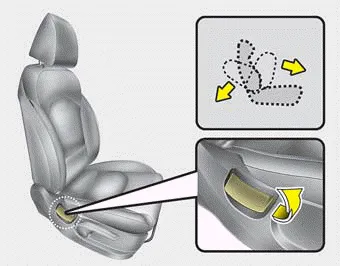
To recline the seatback:
1. Lean forward slightly and lift up the seatback recline lever.
2. Carefully lean back on the seat and adjust the seatback of the seat to the position you desire.
3. Release the lever and make sure the seatback is locked in place. (The lever MUST return to its original position for the seatback to lock.)
Seat Cushion height (if equipped, for driver’s seat)
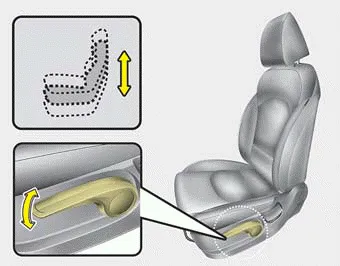
To change the height of the seat cushion, push the lever upwards or downwards.
- To lower the seat cushion, push the lever down several times until the seat reaches the desired position.
- To raise the seat cushion, push the lever up several times until the seat reaches the desired position.
Driver’s seat (1) Forward and backward (2) Seatback angle (3) Seat cushion tilt (4) Seat height (5) Lumbar support* (6) Headrest Front passenger’s seat (7) Forward and backward (8) Seatback angle (9) Headrest Rear seat (10) Armrest (11) Headrest WARNING - Loose objects Do not place anything in the driver's foot well or under the front seats.
The front seat can be adjusted by using the control switch located on the outside of the seat cushion. Before driving, adjust the seat to the proper position so as to easily control the steering wheel, pedals and switches on the instrument panel.
Other information:
Kia Forte 2019-2024 (BD) Owner's Manual: Engine oil
Checking the engine oil level ■ Nu 2.0L MPI Engine (Gasoline) ■ Gamma 1.6L T-GDI Engine (Gasoline) 1. Be sure the vehicle is on level ground. 2. Start the engine and allow it to reach normal operating temperature. 3. Turn the engine off and wait for a few minutes (about 5 minutes) for the oil to return to the oil pan.
Kia Forte 2019-2024 (BD) Owner's Manual: Vehicle identification number, Vehicle certification label
Vehicle identification number (VIN) ■ VIN label The VIN is also on a plate attached to the top of the dashboard. The number on the plate can easily be seen through the windshield from outside. Vehicle certification label The vehicle certification label attached on the driver’s side center pillar gives the vehicle identific
Categories
- Manuals Home
- Kia Forte Owners Manual
- Maintenance
- Blade replacement
- Owner maintenance
- New on site
- Most important about car
